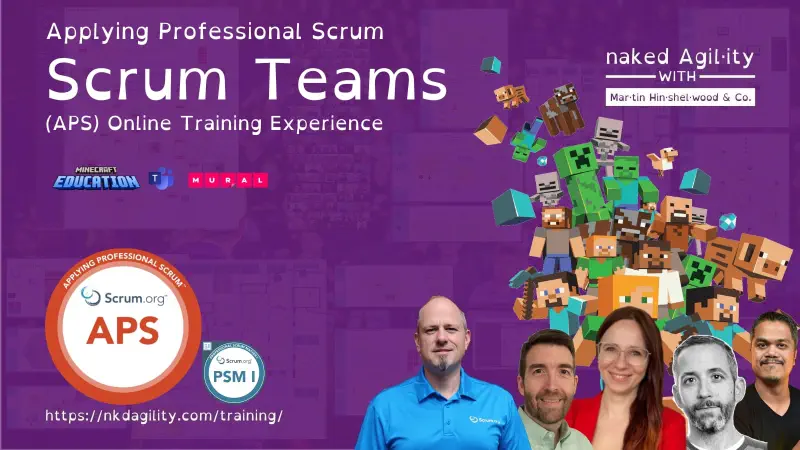
Applying Professional Scrum (APS) Course with Certification

Enables all members of the Scrum Team to learn Scrum while doing it, experiencing what it is like to deliver products using the Scrum framework
APS |Scrumorg |

GOAL: 6 participants

0 Participants
Rolling delivery
Preordering grants you extra coaching, future discounts, and input on scheduling and format.

About Our Funding Model

Our funding model supports busy professionals by ensuring courses are fully funded and guaranteed.

Funding Mode

We proceed with courses only when the participant goal is met, ensuring value and support for everyone involved. Funds are only taken once the target is met.

Collaboration Benefits

Pre-ordering gives exclusive access to help shape the course’s start date, schedule, and format.

Get more information


You need teams that can navigate uncertainty and deliver value consistently—starting now

You’re leading teams through complex product development. Priorities shift. Stakeholders want predictability you can’t give. Teams struggle with unclear direction, delivery friction, and disconnected work. You need more than Scrum theory—you need the confidence to make better decisions under pressure, the capability to guide teams through ambiguity, and practical techniques that work in real organisations.

This course builds that capability. You’ll learn Scrum by doing it—working in Scrum Teams across multiple Sprints, experiencing firsthand how empiricism, transparency, and collaboration create better outcomes than traditional planning. You’ll discover what works, what doesn’t, and why—through hands-on exercises, real team challenges, and reflection on your own work context. You’ll leave with techniques you can apply immediately, the ability to identify and avoid common pitfalls, and validation through the globally recognised Professional Scrum Master I certification.

What you’ll be able to do differently

Make confident decisions in uncertainty

Guide teams through unclear situations using empiricism and transparency rather than prediction and planning

Build team capability for sustainable delivery

Create conditions where teams collaborate effectively, self-organise around value, and improve continuously

Navigate common Scrum pitfalls before they derail you

Recognise anti-patterns early and apply proven practices that keep Scrum effective in your context

Connect Scrum practices to real organisational challenges

Apply what you learn to your actual work—not theoretical scenarios—from the first week

Develop an Agile mindset beyond process mechanics

Shift from output-focused delivery to outcome-focused experimentation and learning

Support or join Scrum Teams effectively

Contribute meaningfully whether you’re a team member, new joiner, or working alongside Scrum Teams

How NKD Agility makes this different

This is a Scrum.org course delivered with NKD Agility’s immersive learning approach—designed to build lasting capability, not just knowledge transfer.

Most Scrum training fails because participants return to work and can’t apply what they learned. They have information but not integration. NKD’s immersive format solves the real bottleneck: time to apply, reflect, and refine. You’ll experience Scrum across multiple Sprints during the course itself, work through real team dynamics, and learn by doing—not just by listening.

Hands-on Scrum experience: Work in Scrum Teams over a series of Sprints, experiencing what it’s like to deliver using Scrum
Real challenges, not theory: Interactive exercises including Minecraft simulations that surface real collaboration, planning, and delivery challenges
Pattern recognition from 20+ years: Martin Hinshelwood’s technical depth and organisational experience means you get context and insight beyond the Scrum Guide
Practical techniques you can use immediately: Leave with a set of proven practices that enhance your application of Scrum in your organisation
Foundation for deeper learning: Establishes the Scrum knowledge needed for advanced role-focused training (Scrum Master, Product Owner, Developer)

Choose the format that works for you

Both formats include the same comprehensive content and certification. Choose based on your schedule and learning preference.

Immersive Learning (Recommended)

8 sessions over 8 weeks, with offline exercises between sessions to apply learning in your real work context.

  • Better retention through spaced learning
  • Apply concepts to real challenges between sessions
  • Deeper integration with your current work
  • Build lasting capability, not just knowledge

Traditional Format

2-day intensive delivery when time constraints require faster completion.

  • Complete course in 2 consecutive days
  • Hands-on exercises and real-world examples
  • Full certification included
  • Available for time-constrained situations
Public classes: View the schedule and join upcoming sessions. Private training: Contact us to arrange tailored delivery for your team or organisation. Learn More

What the course covers

The Applying Professional Scrum course is the perfect introduction, reboot, or refresher to Scrum. It’s excellent training for organisations, teams, and individuals wanting to experience the benefits of Scrum, or for those interested in continuing their learning with more advanced training.

Agility as a new way of working

How Scrum differs from traditional plan-driven models and why that creates better outcomes

Exploring the Scrum framework

Roles, events, artifacts, and the theory that makes them effective

Planning and forecasting with Scrum

How to make decisions and set direction in complex environments

Getting started with Scrum

Practical steps to apply Professional Scrum with your team, including identifying first actions

Common pitfalls and how to avoid them

Learn what doesn’t work and why, so you can navigate challenges confidently

Professional Scrum principles in practice

Build professionalism, experimentation, and outcome-focus into how you work

Is this course for you?

This course is designed for anyone involved in or curious about using Scrum. It’s particularly valuable for:
Professionals currently using Scrum who need a refresher to get the most out of their practice
New team members joining Scrum Teams who need foundational knowledge quickly
Individuals working alongside Scrum Teams who want to collaborate more effectively
Professionals evaluating Scrum to see if it makes sense for them and their colleagues
Organisations adopting Scrum who want teams to learn together and align on approach
Anyone building foundational knowledge before continuing with role-focused training (Scrum Master, Product Owner, Developer, Leader)

Certification and validation

Upon completion, all participants receive a password to attempt the globally recognised Professional Scrum Master I (PSM I) assessment. This certification validates your foundational Scrum knowledge and is recognised worldwide.

The course includes two free attempts at the PSM I exam. Certification is validation of capability—not the primary goal. The real value is the confidence to make better decisions and the practical techniques you can apply immediately.

PSM I certification

Industry-recognised validation of Scrum knowledge

Two free exam attempts included

Reduce risk and pressure

PMI PDU eligible

Claim 14 PDUs for course attendance (under PMI’s third-party provider category)

No pass-rate guarantees

We focus on building capability, not exam coaching—but participants typically perform well because they’ve applied the learning

Before you join

To make the most of the course, please complete these preparation steps:

Study the Scrum Guide

Pass the Scrum Open assessment

Bring real work challenges

The course works best when you can connect learning to your actual context
Ready to build Scrum capability? Whether you’re joining individually or enrolling a team, NKD Agility’s Applying Professional Scrum course gives you practical capability—not just theory—that works from day one. View upcoming classes and enrol

Continue your Scrum learning journey

After completing APS, consider these role-focused courses for deeper capability:

Why Learn With NKD Agility?

  • We are 4.8-star rated on Trustpilot!
  • We have helped 2,600+ people learn Scrum since 2010.
  • We are not trainers, we are consultants that are still in the trenches.
  • All participants get self-paced learning support.
  • Receive regular chances to attend another course at no cost.

Syllabus

Our comprehensive syllabus is designed to accommodate various learning styles, whether you prefer a traditional in-depth session, a flexible immersive experience, or a structured mentor program. Each session can be delivered in the following formats:

Our immersive programs empower growth through incremental learning, outcome-based assignments, and facilitated reflections, ensuring that the skills you gain are practical, applicable, and ready to be used in your work environment. Facilitated Reflections are a cornerstone of our immersive approach, allowing participants to engage deeply with the material. In each session, you will have the opportunity to reflect on your learning, discuss challenges and successes with peers, and gain actionable feedback from professional trainers. These reflective sessions enhance understanding, foster continuous improvement, and support your growth in a collaborative environment.

Kickoff & Sprint 1

Session 1 90+
Participants are able to experience building complex products within a timebox, which emphasizes the challenges of self-management, team formation, and norming. Through this exercise, they gain insights into the importance of “Getting to Done,” the potential for self-management anywhere (with supportive guidelines), and how the Scrum framework aids in managing complex product development.
Ask Facilitate a discussion within your organization about your current process and practices used for product development and create an explicit description of them.
View Examples

Fundamentals of Scrum

Session 2 90+
Students understand the concept of Agile and Scrum, its benefits for managing complexity, and being able to identify and explain how their organization could benefit from applying those principles.
Ask Identify improvement in your current process based on your understanding on how the principles of Agile and Scrum can benefit the team in addressing complexities in product development and apply at least one change to validate its feasibility.
View Examples

Exploring the Scrum Framework

Session 3 120+
By analyzing the Scrum Framework, demonstrate an understanding of how each element serves a specific purpose, and apply this knowledge to create a practical implementation plan that fully utilizes the Scrum Framework.
Ask Identify deviations of your current process from Scrum as defined in the Scrum Guide and apply at least one change that reduces the differences.
View Examples

Sprint Two

Session 4 75+
By understanding that self-management requires boundaries in the form of a minimal set of rules students will be able to improve their work by applying the Scrum Framework.
Ask Through an evaluation of the current Scrum implementation, identify opportunities for improvement, demonstrate how establishing boundaries aligned with the Scrum Framework can enhance self-management, and implement changes that enable the team to work more empirically and achieve their goals more effectively.
View Examples

Deeper into the Scrum Framework

Session 5 75+
Being able to apply improvements to the conduct of Scrum Events by utilizing the transparency provided by Scrum Artifacts to enhance inspection and adaptation, demonstrating the ability to identify and implement changes that enable the team to work more effectively towards achieving their goals.
Ask Evaluate how you are currently using transparency in your Scrum Events to inspect and adapt and apply at least one improvement to increase transparency or improve the flow of the Scrum Event.
View Examples

Sprint Three

Session 6 90+
Effective collaboration is enabled through positive behavior of team members and by living the Scrum Values. When these values are embodied by the Scrum Team and the people they work with, the empirical Scrum pillars of transparency, inspection, and adaptation come to life building trust. Teams that master collaboration are more likely to achieve their goals and deliver value to their customers. Great collaboration needs continuous attention of team members and courage and openness to hold each other accountable.
Ask Evaluate together with your team(s) how good they are collaborating and if there are any behaviors in the team that are impacting their ability to achieve their goals. Identify and apply at least one improvement that helps the team to collaborate better and acquire feedback on the impact of this change.
View Examples

Planning With Scrum

Session 7 90+
Students will be able to evaluate their current process and assess how it affects their ability to work in an empirical way to develop a plan to enhance agile planning.
Ask By evaluating your team’s current process, identify how it affects the ability to work in an empirical way and develop a plan to apply at least one improvement to enhance agile planning to assess the impact of this change.
View Examples

Sprint Four

Session 8 90+
Students will be able to analyze the interactions between their Scrum Team(s) and external individuals or groups, identify challenges at these interfaces, design and implement an improvement strategy, and evaluate its impact on the team’s ability to work empirically and achieve their goals.
Ask Assess the interactions between your Scrum Team(s) and external individuals or groups to pinpoint any challenges at these interfaces. Then, implement at least one improvement and measure its impact on the team’s ability to work empirically and achieve their goals.
View Examples

Getting Started

Session 9 45+
Students will be able to assess their current implementation of Scrum, analyze potential improvements, and develop a vision for what it could look like in the future. Additionally, they will be able to plan first steps that bring them closer to this vision.
Ask Assess your current implementation of Scrum, and develop a vision for what it could look like six months from now. Create a 15% solution to start the journey towards this vision.
View Examples

Closing

Session 10 30+
As we conclude the Applying Professional Scrum course, this final session is designed to reflect on your learning journey, consolidate key concepts, and prepare you to apply your new skills confidently within your team. We’ll revisit the course highlights, address any remaining questions, and provide guidance on the next steps to continue your growth as a Scrum Master.
  • Passing score: 85%
  • Time limit: 60 minutes
  • Number of Questions: 80
  • Format: Multiple Choice, Multiple Answer, True/False
  • Language:
  • Free Credly digital credential included
  • Practice assignment Scrum Open
  • Passwords have no expiration date, but are valid for one attempt only
  • Lifetime certification - no annual renewal fee required

Catchup & After

Two weeks after completion, participants are invited to join a follow-up catch-up session designed to address any remaining questions, ideas, or challenges that have emerged since the training. This session provides an opportunity to reflect on your experiences applying the concepts learned in the course, share insights, and receive additional support.

* Assignments are part of our Immersive Training Programs, encouraging participants to apply their learning practically between sessions for a more hands-on experience.

If we don't have dates that suit you, please sign up to be the first to know, or contact us for discounts or private training.

For those looking for a more guided, continuous learning journey, explore our Mentor Programs, where you can engage in a series of immersive learning sessions combined with ongoing mentorship.


Connect with Martin Hinshelwood

If you've made it this far, it's worth connecting with our principal consultant and coach, Martin Hinshelwood, for a 30-minute 'ask me anything' call.

Our Happy Clients​

We partner with businesses across diverse industries, including finance, insurance, healthcare, pharmaceuticals, technology, engineering, transportation, hospitality, entertainment, legal, government, and military sectors.​

YearUp.org Logo

YearUp.org

Lean SA Logo

Lean SA

Lockheed Martin Logo

Lockheed Martin

Milliman Logo

Milliman

Qualco Logo

Qualco

Big Data for Humans Logo

Big Data for Humans

Ericson Logo

Ericson

CR2

Flowmaster (a Mentor Graphics Company) Logo

Flowmaster (a Mentor Graphics Company)

Slaughter and May Logo

Slaughter and May

Hubtel Ghana Logo

Hubtel Ghana

Kongsberg Maritime Logo

Kongsberg Maritime

ProgramUtvikling Logo

ProgramUtvikling

Boeing Logo

Boeing

Cognizant Microsoft Business Group (MBG) Logo

Cognizant Microsoft Business Group (MBG)

DFDS Logo

DFDS

Boxit Document Solutions

Illumina Logo

Illumina

Department of Work and Pensions (UK) Logo

Department of Work and Pensions (UK)

Royal Air Force Logo

Royal Air Force

Ghana Police Service Logo

Ghana Police Service

New Hampshire Supreme Court Logo

New Hampshire Supreme Court

Washington Department of Transport Logo

Washington Department of Transport

Nottingham County Council Logo

Nottingham County Council

Jack Links Logo

Jack Links

Trayport Logo

Trayport

Brandes Investment Partners L.P. Logo

Brandes Investment Partners L.P.

Boeing Logo

Boeing

Big Data for Humans Logo

Big Data for Humans

ProgramUtvikling Logo

ProgramUtvikling